Helicopter Forestry Services: Supporting Wildfire Prevention, Fuels Reduction, and Forest Health

Forestry Services

Across the western United States, land managers face a difficult combination of increasing wildfire risk, overstocked forests, and rugged terrain that limits ground access. In many of these landscapes, conventional equipment cannot safely reach steep slopes or ecologically sensitive areas without major road-building and soil disturbance.

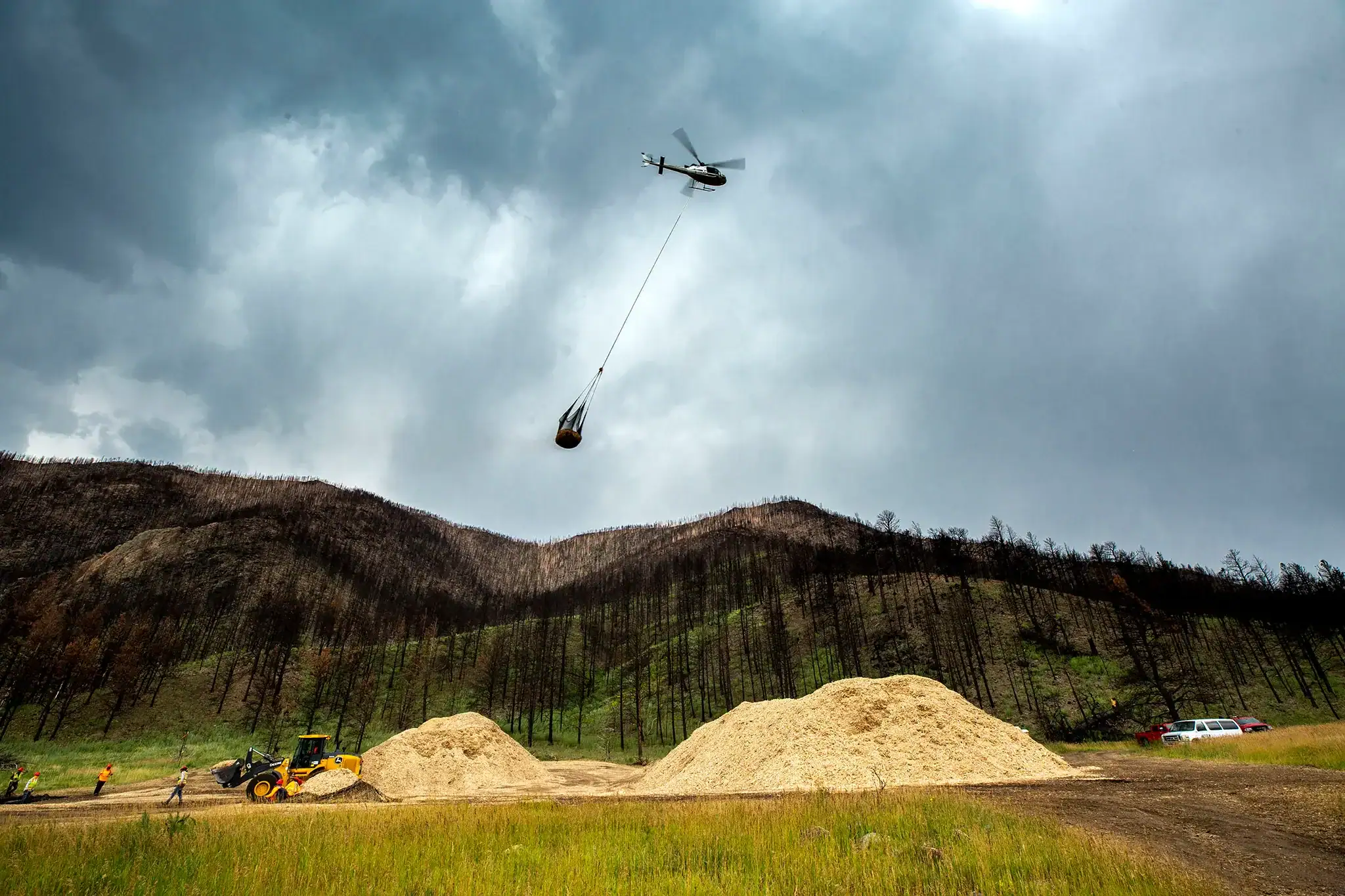
Helicopter forestry services offer an alternative. By pairing vertical-lift capability with specialized forestry crews, operators like R&R Conner Aviation help agencies and private landowners reduce hazardous fuels, remove high-value timber, perform aerial mulching, and support post-fire rehabilitation where ground machines simply cannot go.


What Are Helicopter Forestry Services?

Helicopter forestry services encompass a suite of aerial operations that support forest management and wildfire mitigation, including:

  • Heli-logging and timber extraction
  • Hazardous fuels reduction and thinning
  • Aerial mulching and site reclamation
  • Fireline and fuel break construction support
  • Forestry aerial mapping and data collection

Instead of pushing roads and heavy equipment into fragile or remote stands, helicopters lift logs, equipment, and materials vertically and move them to suitable landings or processing sites. Research and agency guidance note that helicopter-based timber extraction can significantly reduce the need for road building and skidding, thereby lowering soil disturbance and protecting watersheds.US Forest Service+1

R&R Conner Aviation leverages this approach through full-cycle operations in partnership with 406 Timber, providing not just lift capability but planning, cutting, hauling, and cleanup.


Heli-Logging: Timber Extraction with Reduced Ground Impact

Traditional ground-based logging relies on skidders, yarders, and trucks—machines that require an extensive road network and can leave deep ruts, disturbed soils, and compacted ground. In steep or wet terrain, those impacts may be unacceptable.

Heli-logging works differently:

  1. Select trees are felled by ground crews using low-impact methods.
  2. Helicopters lift pre-bunched or individual stems using chokers or grapples.
  3. Logs are flown to a landing area where they can be processed and loaded onto trucks.

Agency and technical documents emphasize several advantages of helicopter extraction: it can be used on almost any terrain, reduces the number of new roads required, and can produce substantial timber volume while reducing environmental impact compared with many ground-based systems.US Forest Service+1

For landowners and agencies balancing revenue from timber sales with long-term watershed and habitat protection goals, those benefits are significant.


Hazardous Fuels Reduction and Wildfire Prevention

Decades of fire suppression and changing climate conditions have left many forests with dense stands of smaller trees and accumulated surface fuels. These “ladder fuels” allow fire to climb into the canopy and burn with high intensity.

Helicopter forestry services support hazardous fuels reduction in several ways:

  • Thinning overstocked stands in inaccessible areas
    Helicopters can move equipment and personnel into steep slopes where mechanical thinning machines cannot operate safely. Thinned material can be extracted, chipped, or mulched using aerial support.
  • Supporting creation of strategic fuel breaks
    Fuel breaks designed along ridges, roads, or community edges often require treatment in rugged terrain. Helicopters deliver crews, chippers, and other vegetation management equipment into these locations and remove processed material when needed.
  • Assisting with prescribed fire preparations
    In some projects, helicopters help prepare units for prescribed burning by supporting thinning, pile building, or transport of ignition crews and equipment.

R&R Conner Aviation’s experience with federal IRSC (Integrated Resource Service Contracts) positions the company to meet strict wildfire prevention and fuels reduction requirements while coordinating closely with agencies such as the U.S. Forest Service and Bureau of Land Management.


Aerial Mulching and Post-Fire Reclamation

After logging or wildfire, exposed soils on steep slopes can erode quickly, threatening downstream infrastructure, water quality, and habitat. Aerial mulching—spreading wood fiber, straw, or other materials across impacted slopes—is a proven tool for reducing erosion and stabilizing soils.

Helicopters play a key role by:

  • Transporting mulching equipment and materials into remote burn scars or harvest units
  • Precisely applying mulch on steep slopes where ground machinery cannot safely operate
  • Supporting follow-up treatments such as seeding or installation of erosion-control structures

By integrating aerial mulching with timber removal and fuels reduction, R&R Conner Aviation and its partners can provide a full cycle of disturbance–treatment–recovery, supporting faster ecosystem resilience.

For more information on how helicopters are used in forest operations, the U.S. Forest Service provides an overview of helicopter extraction equipment and considerations in its Helicopter Equipment Catalog. US Forest Service


Forestry Services in Support of Wildfire Response and Recovery

Helicopter forestry services are not limited to proactive management. They also play a vital role in wildfire response and recovery:

  • Support for fireline construction and mop-up
    Helicopters can move crews, saws, and pumps into remote ridges where dozers cannot operate, and supply water or foam to support mop-up operations.
  • BAER (Burned Area Emergency Response) team support
    Post-fire assessment teams rely on access to steep slopes, drainages, and ridgelines. Helicopters can insert teams, move monitoring equipment, and transport erosion-control materials into these areas.
  • Post-fire hazard tree removal
    Where fire-damaged trees threaten roads, powerlines, or infrastructure in steep terrain, heli-logging techniques allow safe removal without exposing ground crews to hazardous snags.

R&R Conner Aviation’s Natural Disaster Recovery services complement forestry operations by providing rapid access, debris removal, and post-fire stabilization support when communities most need it.


Full-Cycle Forestry: Integrated Operations with 406 Timber

One of the key differentiators for R&R Conner Aviation is its integrated relationship with 406 Timber. Instead of treating helicopter services as a stand-alone lift solution, the combined team can provide:

  • Planning and layout for heli-logging units, fuel breaks, and treatment blocks
  • Cutting and felling operations aligned with helicopter extraction requirements
  • Lifting and hauling of logs, chips, or equipment via UH-1 helicopters
  • Site cleanup and reclamation, including slash treatment and aerial mulching

This vertical integration streamlines coordination, reduces the number of contractors on site, and ensures that aviation, forestry, and reclamation decisions are aligned from day one.

To see how this integrated approach is positioned for land managers and agencies, review R&R Conner’s Forestry Services page, which outlines full-cycle timber management, fuels reduction, and IRSC contract experience.


When Helicopter Forestry Services Make the Most Sense

While helicopters are a premium tool, they are often the most practical—or only—solution when:

  • Access is limited or impossible by road. Steep slopes, wetlands, and fragile soils can make road construction prohibitively expensive or environmentally unacceptable.
  • High-value timber stands exist in difficult terrain. Heli-logging can make it economically viable to remove high-value timber without widespread ground disturbance.
  • Fuels reduction must occur near communities in rugged landscapes. Strategic fuel breaks above communities or critical infrastructure often require aerial support.
  • Post-fire landscapes pose safety hazards. Steep, unstable slopes, hazard trees, and damaged roads can make ground-based rehabilitation unsafe.

In these scenarios, helicopter forestry services can reduce project duration, minimize environmental impact, and improve personnel safety, all while enabling work that would otherwise not be feasible.


Selecting a Helicopter Forestry Partner

When evaluating providers for helicopter forestry services, land managers and agencies should consider:

  1. Forest management experience, not just flight time
    Operators who understand timber sale logistics, IRSC requirements, and fuels reduction objectives can better align aviation plans with silvicultural goals.
  2. Fleet suitability and performance
    Helicopters must have sufficient lift capacity and performance margins for high-altitude, high-temperature operations typical in western forests.
  3. Safety programs and regulatory compliance
    Look for adherence to FAA external-load regulations, robust crew training, and a strong safety culture in both aviation and ground operations.
  4. Integration with ground-based forestry crews
    Integrated operations with logging and fuels reduction partners reduce coordination risk and improve efficiency.
  5. Proven work with government agencies
    Experience with federal and state contracts demonstrates the ability to meet strict standards in documentation, safety, and environmental compliance.

Partner with R&R Conner Aviation for Your Next Forestry Project

From heli-logging and hazardous fuels reduction to aerial mulching and post-fire rehabilitation, helicopter forestry services are a powerful tool for managing forests in steep, remote, and sensitive terrain.

R&R Conner Aviation combines proven UH-1 helicopter capability, full-cycle forestry operations through 406 Timber, and extensive experience on federal IRSC and private projects to deliver reliable, safe results.

To explore options for your forest or fuels project:

By integrating aviation, forestry, and reclamation expertise, R&R Conner Aviation helps land managers reduce wildfire risk, protect watersheds, and keep forests healthy—wherever the terrain demands a vertical solution.

How Utility Helicopter Power Line Services Improve Safety and Reliability in Remote Terrain

As the North American grid continues to expand and modernize, transmission owners face growing pressure to improve reliability and resilience, even in the most remote terrain. Federal studies show that nearly every region of the United States would gain reliability and resilience benefits from additional and upgraded transmission infrastructure.The Department of Energy’s Energy.gov+1 At the same time, new projects increasingly push into mountainous, forested, and environmentally sensitive areas where traditional access is slow, costly, and risky.

That is where utility helicopter power line services become indispensable. By pairing heavy-lift helicopters with highly trained crews, transmission owners can build, inspect, and maintain power lines more safely and efficiently—without carving roads through rugged terrain or exposing ground crews to unnecessary hazards.

R&R Conner Aviation specializes in this kind of high-consequence work, using medium-category UH-1 “Huey” helicopters and experienced external-load pilots to support power line projects across the western United States.


Why Remote Power Line Projects Are So Challenging

Transmission lines rarely follow easy routes. To connect generation to population centers, utilities must cross:

  • Steep mountain ridges
  • Deep river valleys and canyons
  • Dense forests with limited or no road networks
  • Environmentally sensitive habitats where road building is tightly restricted

Traditional, ground-based approaches to construction and maintenance struggle in these environments:

  • Access roads are expensive and slow to build. Heavy equipment and material movement can require miles of new or upgraded roads, each requiring design, permitting, and environmental review.
  • Safety risks increase for crews. Linemen and construction teams may face steep slopes, unstable ground, and long approaches on foot or by off-road vehicles.
  • Outages can stretch longer than necessary. When a line trip occurs in a hard-to-reach corridor, it can take days just to reach and assess the problem.

By contrast, a properly equipped utility helicopter can bypass most of these obstacles in a single lift.


How Utility Helicopters Transform Power Line Construction and Maintenance

1. Rapid access to hard-to-reach structures

Helicopters can put crews, tools, and small equipment directly at remote structures in minutes. Industry experience has shown that aerial access dramatically reduces the time required to patrol and assess defects compared with ground-based inspection alone.Fair Lifts Helicopter Services+1

This translates to:

  • Faster identification of damaged components
  • Shorter outage durations
  • Less time spent traversing difficult or dangerous terrain

2. A safer working platform for specialized tasks

For many tasks—such as insulator replacement, spacer installation, or live-line work—helicopters provide a stable, controlled platform that reduces the need to climb towers or work from high-reach equipment on unstable surfaces. External research on utility helicopter work notes that aerial platforms can reduce exposure to fall hazards and other risks associated with tower climbing and ground-based access.LinkedIn+1

3. Heavy-lift support for foundations and structures

In remote corridors, moving concrete, steel, and hardware is often the bottleneck. Heavy-lift helicopters like R&R Conner Aviation’s UH-1s can carry:

  • Foundation concrete via precision bucket operations
  • Steel tower components and crossarms
  • Hardware pallets, conductor reels in segments, and tools

By flying directly from staging areas to structure sites, helicopters can replace days or weeks of road-building and ground transport with a single well-planned airlift.

4. Efficient routine inspection and vegetation patrols

Routine visual patrols remain a key part of transmission maintenance programs. Many utilities now rely on helicopters to:

  • Conduct low-level visual inspections of conductors, insulators, and structures
  • Identify vegetation encroachment along rights-of-way
  • Capture high-quality imagery for engineering review

Industry and regulatory bodies emphasize vegetation management and regular inspection as central pillars of transmission reliability.Federal Energy Regulatory Commission Helicopters help utilities meet these expectations, especially on long spans through inaccessible terrain.

5. Storm response and emergency restoration

After storms, wildfires, or landslides, roads may be blocked or destroyed. Utility helicopter power line services are vital for:

  • Rapid aerial damage assessment
  • Transporting crews and emergency hardware to damaged structures
  • Removing downed trees and debris from lines in inaccessible areas
  • Supporting temporary structures and emergency rebuilds

This combination of speed and flexibility is critical when communities are waiting for power to be restored.


How R&R Conner Aviation Supports Power Line Owners

R&R Conner Aviation has been operating from Montana’s rugged landscape since 2005, giving the company deep experience with challenging terrain, high-altitude density altitude, and year-round operations.

Key elements of the company’s utility helicopter power line services include:

Heavy-lift UH-1 Huey fleet

R&R Conner operates UH-1 Huey helicopters specifically configured for utility and external-load work. Their lift capacity and performance in hot-and-high conditions make them well suited for foundation pours, structure erection, and long-line material transport where other platforms may struggle.

External-load and vertical-reference expertise

Utility work requires pilots who are comfortable flying:

  • Long-line operations in complex terrain
  • Precision placement of steel, hardware, and foundation buckets
  • Hover operations near energized infrastructure under strict safety protocols

R&R Conner’s crews are trained and operated under FAA guidelines for rotorcraft external-load operations, which set expectations for training, procedures, and risk mitigation in this specialized mission set.Federal Aviation Administration

Remote access and foundation support

From remote foundation pours to material delivery, R&R Conner’s helicopters help transmission owners avoid building roads solely for short-term construction access. Instead, concrete, rebar, and small equipment can be flown directly to foundation sites, minimizing ground disturbance and environmental impacts.

Storm and emergency restoration

The same skill set used for planned projects applies during emergencies. When storms or wildfires damage transmission corridors, helicopters can be rapidly staged to:

  • Survey damage
  • Deliver emergency materials
  • Support temporary structures and rebuilds

R&R Conner’s Power Line helicopter services page provides additional detail on specific capabilities, from pole setting to storm cleanup and remote material transport.


When Utility Helicopter Power Line Services Add the Most Value

While helicopters are not needed on every project, they often provide exceptional value in situations such as:

  • Mountainous or canyon terrain where access roads are impractical
  • Environmentally sensitive areas where ground disturbance must be minimized
  • River crossings or wetlands where heavy equipment access is limited
  • Long-distance rebuilds after major storms or wildfires
  • Upgrades requiring large, heavy components on existing structures in hard-to-reach spans

In many of these cases, the aerial solution is not only faster but can be more cost-effective once total road-building, permitting, and schedule risks are considered.


Choosing a Utility Helicopter Partner for Your Next Project

When evaluating partners for utility helicopter power line services, consider:

  1. Experience with transmission projects
    Look for a track record in power line construction, maintenance, and storm restoration—especially in terrain similar to your project.
  2. Fleet capability
    Verify that the helicopters in use have the lift capacity, performance, and external-load approvals required for your planned lifts.
  3. Safety culture and certifications
    Review safety programs, training standards, and how closely the operator follows FAA guidance on external-load operations and work around energized infrastructure.
  4. Project planning and coordination support
    Strong operators engage early in planning, advising on staging areas, lift plans, and risk mitigation strategies that save time and reduce change orders.
  5. Year-round readiness
    Projects and emergencies are not limited to a single season. An operator that flies year-round in challenging conditions can support you whenever issues arise.

Put R&R Conner Aviation to Work on Your Next Transmission Project

Whether you are planning a new transmission corridor, upgrading existing structures, or preparing for storm season, utility helicopter power line services can dramatically improve safety, speed, and reliability.

To discuss your next project, you can:

By combining proven helicopters, experienced crews, and a deep understanding of utility work, R&R Conner Aviation helps keep power flowing—no matter how remote the line.

Utility Aviation Services: Precision, Reliability, and Efficiency in Critical Field Operations

Utility aviation services

Supporting Critical Infrastructure with Utility Aviation Services

Modern infrastructure depends on reliable access, rapid response, and efficient field execution. Utility aviation services play a vital role in maintaining and developing the systems that power communities, connect regions, and support industry. For remote terrain, rugged landscapes, and time-sensitive operations, helicopters provide the only practical solution.

At R&R Conner, our experience in helicopter-based utility support allows us to safely execute precision lift operations, remote logistics, aerial inspection, and emergency response missions across diverse environments in the Western United States. Our customers include utility contractors, electric cooperatives, government agencies, and private developers who rely on aerial capability to complete critical work efficiently and safely.

Understanding Utility Aviation Services

Utility aviation services cover a wide scope of aerial support functions essential to infrastructure and environmental operations. These typically include:

Power Line & Transmission Support

  • Tower structure placement
  • Hardware delivery and precision long-line installations
  • Conductor stringing and pulling
  • Helicopter power line maintenance and inspections
  • Emergency storm restoration

Remote Construction & Logistics

  • Transporting tools, materials, and personnel to inaccessible locations
  • Staging equipment in steep, forested, or mountainous terrain
  • Supporting bridge, tower, and telecom site construction

Forestry & Vegetation Management

  • Timber and brush removal lifts
  • Aerial mulching operations for land clearing and fire mitigation
  • Vegetation clearance along transmission and utility corridors

Environmental & Utility Survey Missions

  • Right-of-way analysis
  • Thermal imaging and visual inspections
  • Remote site access for environmental crews

Utility aviation services are often the most effective—and sometimes the only—method for servicing locations inaccessible to ground-based equipment.

Precision Long-Line Operations

Many utility aviation services missions require precise delivery or removal of loads from tight corridors and elevated positions. Our long-line specialists are trained to perform high-accuracy external load operations for:

  • Steel structures
  • Wooden utility poles
  • Fuel, water, and supply pods
  • Equipment and machinery
  • Vegetation debris and timber bundles

The ability to place these loads safely and accurately eliminates the need for disruptive road construction, staging, or crane mobilization, reducing environmental impact and project timelines.

Safety in Utility Aviation Services

Utility missions involve complex flight environments—steep slopes, wires, variable weather conditions, and confined landing zones. R&R Conner approaches every flight with an uncompromising commitment to safety, grounded in:

  • Federal regulations for external-load compliance
  • Aircraft maintained by experienced A&P professionals
  • Highly trained long-line pilots with mission-specific experience
  • Rigorous pre-flight planning and real-time communication protocols
  • Situational risk assessments for each operational phase
  • Redundant emergency release systems and operational safety checks

We partner closely with ground crews, utility supervisors, and emergency personnel to ensure safe coordination from planning to execution.

Real World Applications

Our utility aviation services support:

  • Electrical transmission and distribution networks
  • Telecommunications towers and microwave sites
  • Forest service and environmental protection operations
  • Mining and industrial access projects
  • Emergency management and disaster relief logistics
  • Remote construction and surveying teams

In rugged and remote environments, helicopters are often the only viable solution to maintain operational continuity and minimize service disruption to communities.

Why Organizations Choose Aerial Utility Services Support

Choosing helicopter-based utility support provides measurable benefits:

SpeedRapid response to outages, construction needs, and emergencies
AccessReach areas unreachable by ground vehicles and cranes
Environmental ProtectionMinimal ground disturbance and no road construction
SafetyReduced worker exposure to dangerous terrain and live lines
PrecisionAccurate placement of loads and equipment in tight corridors
Cost-EffectivenessLower total project time and resource demands

These advantages make aerial support an essential tool for modern utility and construction programs.

A Trusted Partner for Field-Critical Aviation

Utility aviation services require more than aircraft—they demand expertise, discipline, and a commitment to safety and mission success. With decades of field operations experience, R&R Conner brings proven capability and reliability to every lift, inspection, and logistical mission.

From high-elevation transmission corridors to dense forest terrain and mountaintop infrastructure, we support the crews and organizations responsible for powering communities and protecting resources.

Forestry Helicopter Services: Precision, Safety, and Efficiency for Modern Land Management

forestry helicopter services

Forestry Helicopter Services in Modern Resource Management

Forestry operations often take place in rugged terrain where conventional ground equipment cannot reach. Forestry helicopter services provide an essential link between environmental stewardship and efficient land management, offering the ability to move timber, mitigate wildfire risk, and support sustainable resource operations safely and quickly.

For decades, R&R Conner has supported forestry and natural resource projects throughout the Western United States. Our aerial expertise, precision long-line capability, and experienced crews enable us to deliver reliable, field-proven solutions for clients managing large forest tracts, public lands, or commercial timber projects.

Applications of Forestry Helicopter Services

Forestry helicopter services encompass a broad range of aerial operations that enhance safety, efficiency, and environmental performance. These include:

1. Timber Harvest and Heli-Logging

Helicopter-assisted logging (heli-logging) allows selective or full-tree harvesting without the need for road construction or large ground crews. Aircraft lift cut logs directly from slopes or remote stands to a central landing zone for processing or transport. This minimizes soil disturbance, reduces erosion, and helps preserve the integrity of sensitive ecosystems.

2. Aerial Mulching and Vegetation Management

Forestry helicopters are equipped with specialized mulching or mastication attachments to process vegetation efficiently across large or steep areas. Aerial mulching supports wildfire prevention projects, right-of-way maintenance, and slope stabilization efforts.

3. Fire Suppression and Fuel Reduction

Helicopters play a vital role in wildfire response—transporting crews, delivering water or retardant, and assisting in post-burn recovery efforts. They also perform preventive operations like aerial ignition, thinning, and removal of hazardous fuels.

4. Remote Construction and Reforestation Support

In areas inaccessible to trucks or heavy machinery, helicopters transport seedlings, fertilizer, and construction materials for forest roads, bridges, or research stations. Aerial delivery ensures precision placement and reduces environmental impact.

Environmental and Operational Benefits

Forestry helicopter services provide unique advantages that support both operational goals and environmental sustainability:

  • Reduced Ground Impact – Eliminates the need for extensive road networks or heavy equipment staging.
  • Selective Harvest Capability – Enables removal of specific trees to promote forest health and biodiversity.
  • Access to Remote Areas – Provides reach into mountainous or wetland environments that ground crews cannot safely navigate.
  • Rapid Response – Supports firefighting, reclamation, and disaster recovery in hours rather than days.
  • Minimal Soil Disturbance – Preserves sensitive root systems and reduces erosion.

By combining these advantages, helicopter-based forestry services have become a cornerstone of modern, responsible land management.

Equipment and Capabilities

At R&R Conner, our forestry helicopter services rely on proven aircraft platforms and precision equipment. Each helicopter is configured for external-load operations with certified belly hooks, long-line systems, and quick-release mechanisms to ensure safe, efficient handling of loads in all environments.

Our crews are trained in aerial load management, environmental coordination, and compliance with federal external-load regulations, ensuring that every operation meets federal and industry standards. From timber lifting to aerial mulching, our aircraft and ground teams work in tandem to deliver precision outcomes in diverse forestry applications.

Safety and Compliance

Safety and environmental responsibility guide every mission. We adhere to comprehensive operational standards that include:

  • Rigorous aircraft inspections before each lift.
  • Experienced pilots trained in mountain and external-load flight.
  • Pre-mission risk assessments considering terrain, wind, and payload weight.
  • Coordination with environmental agencies and forestry managers.
  • Redundant communication systems for ground-to-air coordination.

By maintaining strict adherence to federal environmental regulations, R&R Conner ensures that forestry operations are conducted responsibly and efficiently.

Supporting Sustainable Forestry

Beyond operational performance, forestry helicopter services play a vital role in promoting sustainable forestry practices. Aerial access allows for low-impact harvesting and replanting, contributing to long-term resource renewal and environmental balance.

Helicopter-assisted techniques are often used in:

  • Selective cutting and stand improvement projects.
  • Post-fire reforestation programs.
  • Aerial seeding and fertilization.
  • Timber salvage after natural disasters.

This integration of technology and stewardship reflects the future of forestry—where aviation supports both production and preservation.

Partnering with R&R Conner

R&R Conner’s commitment to safety, precision, and reliability makes us a trusted partner for forestry operations across challenging terrain. Whether providing aerial lift support, fire mitigation, or timber transport, we deliver dependable results with an emphasis on coordination, environmental respect, and technical excellence.

Our forestry helicopter services are tailored to the needs of both public agencies and private clients, helping to sustain vital natural resources while meeting modern efficiency and safety standards.

From high-elevation timber recovery to wildfire prevention and habitat restoration, forestry helicopter services combine precision aviation with environmental stewardship—helping preserve the forests that sustain our communities.

Helicopter Power Line Maintenance: Ensuring Reliability and Safety from Above

Helicopter Power Line Maintenance

The Critical Role of Helicopter Power Line Maintenance

Modern electrical infrastructure stretches across mountains, forests, and rivers—areas often inaccessible by standard vehicles or ground crews. Helicopter power line maintenance offers a proven way to inspect, repair, and maintain these essential assets safely and efficiently.

For utilities and construction contractors, aerial maintenance reduces downtime, limits environmental impact, and allows teams to reach infrastructure that might otherwise be impossible to service. At R&R Conner, our long history of supporting power-line construction and maintenance projects has made us a trusted partner for aerial utility operations across the Western U.S.

Why Helicopter Maintenance Matters

Power lines represent one of the most critical components of modern infrastructure. Over time, they are exposed to wind, temperature fluctuations, lightning, and vegetation growth—all of which can compromise performance and safety. Routine inspection and maintenance are necessary to:

  • Detect damaged insulators, conductors, or hardware before failure occurs.
  • Clear vegetation encroachment and restore right-of-way clearances.
  • Repair storm-related damage quickly to minimize outages.
  • Upgrade existing lines with modern components for higher reliability.

Using helicopters allows maintenance crews to accomplish these tasks faster, with less environmental disturbance and fewer safety risks to ground workers.

How Helicopter Power Line Maintenance Works

Helicopter-assisted maintenance relies on precision flying and coordinated teamwork. Depending on the project, operations may include:

  1. Aerial Inspection and Imaging – Pilots fly parallel to energized lines while inspectors or cameras identify damage, corrosion, or wear. High-resolution video, thermal, and LiDAR data help utilities plan maintenance efficiently.
  2. Component Replacement – Crews can install or remove insulators, vibration dampers, spacers, or marker balls using long-line or platform techniques.
  3. Conductor and Hardware Repair – Helicopters carry specialized linemen or equipment to perform live-line maintenance, reducing the need for outages.
  4. Vegetation Management – Aerial saw systems and mulching operations clear hazardous growth near conductors safely and rapidly.
  5. Emergency Response – After storms or wildfires, helicopters transport crews, replacement poles, and materials to remote sites for immediate restoration.

Each mission requires close coordination between pilots, maintenance technicians, and utility engineers to ensure precise, safe, and compliant operations.

Advantages of Aerial Maintenance

The benefits of helicopter power line maintenance extend far beyond convenience:

  • Rapid Response – Crews can access remote sections of line within minutes, minimizing outage durations.
  • Minimal Ground Impact – Eliminates the need for access roads or heavy equipment staging in sensitive environments.
  • Safety – Keeps personnel away from steep slopes, rivers, or energized equipment.
  • Precision Work – Long-line and platform operations allow accurate placement of components at altitude.
  • Cost Efficiency – Reduced setup time and fewer man-hours per maintenance cycle translate into long-term savings.

These advantages make helicopter support an essential part of the modern utility-maintenance toolkit.

Safety and Training Standards

Operating near energized high-voltage systems requires absolute attention to detail. R&R Conner’s crews adhere to Federal external-load regulations and rigorous internal safety protocols.

Our maintenance operations include:

  • Certified Pilots and Linemen experienced in live-line and de-energized maintenance techniques.
  • Comprehensive Pre-Flight Planning covering weather, terrain, and load calculations.
  • Aircraft and Rigging Inspections before each mission to confirm readiness.
  • Communication Redundancy via ground-to-air radios and hand-signal procedures.
  • Emergency Release and Quick-Disconnect Systems to mitigate unforeseen risks.

By maintaining strict operational discipline, we ensure that every lift, flight, and maintenance action meets the highest industry standards for safety and precision.

Specialized Equipment and Capabilities

R&R Conner utilizes medium-lift helicopters configured for external-load and personnel-platform operations. Each aircraft is equipped with:

  • Certified belly hooks and precision long-line systems.
  • Swivel and quick-release hardware for safe load control.
  • Dual-pilot or single-pilot configurations depending on mission complexity.
  • Advanced avionics for altitude, GPS positioning, and stability monitoring.

Our in-house maintenance team ensures each aircraft remains in top mechanical condition—ready for power-line missions, whether planned maintenance or emergency response.

Sustaining Power for Communities

From daily patrols to post-storm restoration, helicopter power line maintenance keeps power flowing reliably to homes, businesses, and critical facilities. The ability to maintain and repair infrastructure without building roads or staging cranes reduces both project timelines and ecological impact.

R&R Conner’s commitment to safe, efficient aerial solutions supports the broader mission of strengthening America’s energy backbone—one span of wire at a time.

From precision inspections to complex live-line repairs, helicopter power line maintenance represents the future of utility service and reliability. With experienced crews, proven aircraft, and an unwavering focus on safety, R&R Conner continues to deliver performance where ground access ends and aerial expertise begins.

Helicopter Power Line Construction: Precision, Safety, and Efficiency from the Sky

Helicopter power line construction

Introduction: The Role of Helicopters in Power Line Construction

Helicopter power line construction has transformed how utilities and contractors build and maintain critical infrastructure. Traditional ground methods—requiring road access, cranes, and extensive right-of-way clearing—often fall short in rugged or environmentally sensitive regions. Helicopters solve that challenge by offering speed, precision, and minimal ground disturbance.

At R&R Conner, we integrate aerial construction into utility and energy projects across thelicopter power line construction.he Western U.S., delivering safe, efficient solutions where access and accuracy are paramount. Our teams combine decades of field experience with specialized aircraft and rigging systems to execute demanding line-build projects from start to finish.

How Helicopter Power Line Construction Works

Helicopter power line construction involves moving and installing materials—towers, insulators, wire reels, and hardware—directly from the air using external-load long-line systems. This method reduces the need for heavy ground equipment and minimizes environmental impact.

A typical aerial line-build sequence includes:

  1. Route Survey and Planning – Identifying tower locations, terrain profiles, and safe flight paths.
  2. Material Staging – Positioning structures, hardware, and conductor reels at predetermined drop sites.
  3. Tower Erection and Assembly – Lifting poles, lattice sections, or steel frames into place using precision long-line techniques.
  4. Conductor Stringing and Tensioning – Flying pilot lines across spans for pulling conductors or optical ground wire.
  5. Hardware Installation – Attaching insulators, spacers, and dampers at altitude.
  6. Inspection and Maintenance – Conducting visual surveys and thermographic checks for reliability assurance.

Each stage requires close coordination between pilots, ground crews, and utility engineers to maintain both safety and productivity.

Advantages of Helicopter-Assisted Line Construction

Helicopter-based construction delivers distinct advantages over conventional ground methods:

  • Access to Remote Corridors – Ideal for mountains, wetlands, or areas with restricted vehicle access.
  • Reduced Environmental Impact – Eliminates the need for road-building and large equipment staging.
  • Accelerated Timelines – Projects that once required months of ground mobilization can be completed in weeks.
  • Precision Placement – Long-line pilots achieve sub-meter accuracy during tower placement or conductor stringing.
  • Enhanced Safety – Keeps workers off dangerous slopes, river crossings, and energized lines.

For utilities working under tight outage windows or regulatory constraints, these benefits directly translate into reduced cost and improved reliability.

Safety and Compliance in Helicopter Power Line Construction

Operating near energized corridors demands strict procedural discipline. R&R Conner adheres to Federal external-load standards and utility-industry best practices to ensure every flight meets or exceeds compliance expectations.

Key safety measures include:

  • Certified Flight Crews trained in external-load and energized-line operations.
  • Pre-Mission Risk Assessments covering load weights, weather, and terrain obstacles.
  • Dual Communications Systems for real-time coordination between aircraft and ground teams.
  • Rigging Inspection and Maintenance performed before each lift cycle.
  • Emergency Release Mechanisms tested to allow immediate load jettison in unforeseen events.

Our crews operate with precision and situational awareness—critical attributes when working around infrastructure that powers entire communities.

Applications Beyond Line Installation

Helicopter support extends far beyond new construction. Common aerial-assisted tasks include:

  • Maintenance and Repair – Replacing insulators, spacers, and hardware on existing structures.
  • Storm Damage Response – Delivering crews and materials to isolated restoration sites.
  • Right-of-Way Inspection – Aerial surveys and thermal imaging for early-fault detection.
  • Vegetation Management – Aerial saw operations to maintain safe clearances near conductors.

These services keep critical transmission and distribution networks reliable year-round, especially in mountainous or forested regions where traditional access remains limited.

Equipment and Expertise

R&R Conner operates medium-lift helicopters configured for external-load missions and long-line operations. Our aircraft are equipped with certified cargo hooks, swivel assemblies, and precision long-line systems that allow pilots to position loads accurately from altitude.

Combined with experienced mechanics and FAA-certified maintenance programs, these aircraft ensure reliability during demanding project cycles. Each lift plan is engineered to balance payload, altitude, and environmental conditions—providing consistent performance from start to completion.

Commitment to Precision and Partnership

Helicopter power line construction succeeds through trust and coordination. At R&R Conner, we view every assignment as a collaboration between our crews, contractors, and utility partners. From pre-planning to final inspection, our approach emphasizes communication, safety, and efficiency—principles that define our company’s reputation across the region.

Helicopter power line construction continues to reshape how infrastructure is built and maintained. By combining aviation expertise with utility-sector precision, R&R Conner delivers dependable results where the landscape demands an aerial solution.

Helicopter External Load Operations: Precision Aerial Solutions for Challenging Jobs

Helicopter external load operations

In many industries—construction, utility infrastructure, forestry, remote exploration, and disaster response—moving loads that cannot be carried inside an aircraft is essential. Helicopter external load operations (also called sling load or long-line operations) make that possible by suspending cargo beneath the rotorcraft and delivering it precisely where ground access is minimal or nonexistent. Those capabilities open doors to project sites that would otherwise be inaccessible.

Throughout such missions, success depends on more than horsepower. Meticulous planning, rigorous safety practices, environmental understanding, and detailed rigging protocols all come into play. This page outlines how external load operations work, the classifications, challenges, and how we (as the provider) approach them to ensure reliability and safety.

Helicopter external load operations

What Are Helicopter External Load Operations?

By definition, an external load is cargo that is carried outside the aircraft’s fuselage, suspended below or sometimes beside the rotorcraft. Under 14 CFR Part 133, helicopter external load operations are regulated rotorcraft operations in which loads are attached externally.

The FAA defines several classes (A, B, C, D) of rotorcraft-load combinations based on how the load behaves (jettisonable or not, contact with land or water, etc.).

  • Class A: Load is not jettisonable and does not extend beneath landing gear.
  • Class B: Load is jettisonable, lifted free from land/water.
  • Class C: Jettisonable load remains in contact with land or water at some point.
  • Class D: Loads other than A, B, or C; often used when carrying humans or special operations.

Understanding the class affects allowable operations, required clearances, and safety protocols.

Applications and Use Cases

Helicopter external load operations have broad application across sectors:

  • Utility & Power Infrastructure: Lifting poles, towers, conductors, or transformers into terrain where roads cannot reach.
  • Remote Construction: Installing structural members, prefab building modules, or heavy equipment on remote mountain sites or ridgelines.
  • Forestry / Logging & Vegetation Management: Using helicopters to carry logs, limbs, or biomass in sensitive or steep terrain.
  • Exploration / Seismic / Oil & Gas: Delivering drilling rigs, sensors, fuel, and supplies to inaccessible areas.
  • Disaster Relief & Emergency: Rapid deployment of emergency equipment, rescue gear, or clearing operations in disaster zones where roads are blocked.
  • Aircraft or Equipment Recovery: Retrieving downed aircraft or machinery from remote or sloped terrain when ground retrieval is not feasible.

These examples show the flexibility and reach that helicopter external load operations bring to projects.

Key Factors in Planning

To execute external load operations safely and successfully, numerous variables must be accounted for in advance:

Load Engineering & Rigging

  • Determine weight, center of gravity, load geometry, and sling configuration.
  • Use spreader bars, stabilizing lines, or tag lines to control movement and prevent oscillation or spinning.
  • Design for quick release (when required) and confirmation of safe attachment.

Aircraft Performance & Environmental Conditions

  • Helicopter lift is limited by density altitude—higher elevation or high temperature reduces available lift margin.
  • Wind, turbulence, rotor downwash, and obstacles near terrain influence flight paths.
  • Seasonal conditions (snow, ice, extreme cold, or heat) must be considered when scheduling.

Site Assessment & Staging

  • Clear landing or pickup zones; verify overhead obstructions (power lines, trees); ground conditions must support crew operations.
  • Plan for emergency jettison zones or abort paths where the load can be released safely without harming people or property.
  • Ground crew communication systems and signaling protocols must be robust.

Regulatory & Safety Compliance

  • Helicopter external load operations in the U.S. must comply with FAA Part 133 certification and operating rules.
  • Over congested areas, special flight plans and waivers may be required. 
  • Aircraft and rigging gear must be inspected and documented; pilot and crew training must maintain currency.

Training & Ground Personnel

  • Ground crews must understand rigging, hand signals, safety zones, static discharge, and emergency response.
  • Coordination between air and ground is essential for precise pick-up and drop-off.

Safety Protocols & Operational Controls

Safety underpins every external load operation. Some of the key control measures include:

  • Pre-flight briefings covering roles, signals, hazards, and contingencies.
  • Redundancies (dual hooks, belly bands) especially when loads carry risk, or human external cargo is involved.
  • Load release protocols: pilot-activated systems, back-up releases, or manual releases under supervision.
  • Monitoring of spinning, pendulum motion, or load interaction with rotor downwash.
  • Emergency jettison plans, safety clear zones, and abort protocols in case of problems.
  • Recording load data, hook rates, and inspecting attaching hardware pre- and post-lift.

Challenges & Mitigation

Helicopter external load operations are technically demanding:

  • Wind and turbulence can disrupt control of the load or lead to hazardous oscillation.
  • High elevation or hot conditions reduce lift capability, forcing smaller loads or lighter fuel loads.
  • Obstructions like trees, wires, towers demand careful flight path planning.
  • Variable ground conditions, especially in remote or soft terrain, may compromise staging areas or crew movement.
  • Human error, miscommunication, or unexpected load behavior remain risks unless mitigated by rigorous protocols.

Mitigation comes through preplanning, safety discipline, simulation/drills, conservative margins, and real-time adaptability.

Why Use Helicopter External Load Operations

  • They allow access to sites that would otherwise be unreachable by road, crane, or truck.
  • They reduce environmental disruption—less road building, less ground disturbance.
  • They accelerate project schedules by avoiding the logistics of laborious ground transport.
  • They permit precise placement of equipment or structures in tight spaces or complex terrain.
  • They provide flexibility and scalability across project types and industries.

For a deeper dive into the regulatory framework governing these operations, refer to the FAA’s official document: Part 133 External Load Helicopter Operations. To see more of our work at R&R Conner Aviation, see our services page.

Helicopter Heavy Lift Services: Precision, Power & Performance Across Montana and Beyond

Helicopter Heavy Lift Services: Precision, Power & Performance Across Montana and Beyond

In sectors ranging from infrastructure development and forestry to energy and emergency response, the capability to move large, heavy loads precisely and efficiently can make or break project timelines. Helicopter heavy lift services enable operations in places where conventional methods fail. R&R Conner leverages decades of experience and specialized aircraft to deliver lift solutions that overcome terrain, weather, and access constraints.

Helicopter Heavy Lift Services: Precision, Power & Performance Across Montana and Beyond

Our Heavy Lift Capabilities

Helicopter heavy lift services cover a wide spectrum of applications:

  • Power Line & Utility Construction – Placing poles, towers, and conductors in rugged or inaccessible corridors.
  • Remote Construction – Delivering and positioning prefabricated materials, steel beams, and heavy equipment directly onto sites.
  • Forestry & Vegetation Management – Supporting heli-logging, timber removal, and aerial mulching for slope stabilization or fire mitigation.
  • Seismic & Exploration Work – Transporting equipment, supplies, and personnel into remote exploration zones.
  • Emergency & Disaster Response – Delivering supplies, assisting firefighting operations, and restoring access where roads are blocked.
  • Aircraft Recovery – Safely lifting and removing aircraft from difficult or hazardous terrain.

At R&R Conner, we specialize in these services with our fleet and operational infrastructure in all climates, all seasons, and any location.

How Helicopter Heavy Lift Services Work

Every mission is built on preparation and precision. Key factors include:

  • Load Analysis – Determining weight, balance, and rigging to ensure stability throughout the lift.
  • Site Evaluation – Considering terrain, altitude, and seasonal weather conditions.
  • Flight Planning – Designing safe, efficient routes and staging areas.
  • Safety Protocols – Following strict FAA regulations and external-load best practices to minimize risk.
  • Logistical Coordination – Aligning pilots, ground crews, and equipment for seamless execution.

Safety Standards and Best Practices

Safety is central to every heavy lift operation. Federal Aviation Administration (FAA) regulations govern external load missions, and compliance requires disciplined training, detailed inspections, and well-defined communication between air and ground crews. Loads are rigged using specialized slings, long lines, and swivel hooks designed to minimize swing or spin. Pilots undergo recurrent training for precision hovering and emergency procedures, while ground teams practice quick-release protocols to reduce risk. These layers of preparation ensure that every lift is not only efficient but secure for people, property, and aircraft.

Aircraft Performance and Environmental Factors

Helicopter performance depends heavily on environmental conditions. Density altitude—the combination of elevation, temperature, and air pressure—directly affects lift capability. High mountain terrain and hot summer days reduce performance margins, requiring careful calculation before every lift. Wind patterns, rotor wash interaction with loads, and potential turbulence near ridgelines all influence operational decisions. By accounting for these variables, heavy lift services maintain consistency and reliability in challenging environments.

Seasonal and Terrain Considerations for Helicopter Heavy Lift Services

Operating year-round in Montana and the Mountain West means adapting to the seasons:

  • Winter: Cold weather and snow increase risks of icing, reduced visibility, and ground hazards. Aircraft and crews are equipped for low temperatures and short daylight hours.
  • Spring: Rapid snowmelt and runoff create muddy staging areas, making site selection for load pick-up and delivery critical.
  • Summer: High heat and thin air reduce lift capacity, requiring adjustments to payload weights and fuel planning.
  • Fall: Strong winds and changing weather patterns demand close monitoring and flexibility in scheduling.

Terrain is equally important. Slopes, tree cover, and river valleys create unique wind conditions, while remote sites often lack clear access points for staging. Comprehensive planning ensures that each project accounts for these challenges.

Advantages of Helicopter Heavy Lift Services

  • Access to remote and rugged locations where ground machinery is not practical.
  • Reduced project timelines by eliminating the need for road construction or staging large cranes.
  • Lower environmental impact with minimal soil disturbance and reduced ground traffic.
  • High precision placement for critical infrastructure components.
  • Adaptability across industries and project types.

Practical Examples

  • Installing transmission line structures along steep ridgelines.
  • Delivering building components to mountaintop construction sites.
  • Supporting seismic exploration deep in backcountry areas.
  • Transporting supplies to wildfire crews cut off by blocked roads.
  • Recovering disabled aircraft from remote locations.

Moving Projects Forward

Helicopter heavy lift services provide more than just transportation—they create solutions where other methods fall short. By integrating lift capability with careful planning and rigorous safety standards, it becomes possible to complete demanding projects efficiently, even in the most challenging environments.

Helicopter Long-Line Services: Precision, Reach, and Reliability in the Air

Helicopter long-line services

What Are Helicopter Long-Line Services?

Helicopter long-line services involve transporting or positioning external loads suspended from a helicopter on a steel or synthetic line—often ranging from 50 to 250 feet in length. This technique allows crews to deliver materials, equipment, and structures with remarkable accuracy to areas inaccessible by ground or standard crane operations.

Whether supporting power-line construction, delivering materials to mountaintop sites, or assisting forestry operations, long-line methods bring precision and efficiency to industries that depend on air-based logistics.

At R&R Conner, these operations are part of our core expertise. We conduct long-line lifts safely, efficiently, and in compliance with all federal external-load regulations, ensuring each mission meets both safety and client performance standards.

Why Helicopter Long-Line Operations Are Essential

Helicopter long-line services are indispensable when projects involve:

  • Remote or inaccessible sites – Steep terrain, river valleys, or dense forest where ground access is limited or impossible.
  • Vertical construction and power-line projects – Installing towers, transformers, and conductor reels with centimeter-level precision.
  • Forestry and environmental work – Heli-logging, vegetation management, and aerial mulching to reduce wildfire risk.
  • Disaster response and recovery – Delivering relief supplies, removing debris, and restoring communication or power lines after natural disasters.
  • Infrastructure support – Transporting heavy or oversized equipment for energy, mining, or communications industries.

Because a long-line system allows pilots to maintain clear visual separation from the load, it greatly increases maneuverability and safety in tight or uneven terrain.

Precision and Control in the Air

Long-line flying is among the most demanding helicopter skills. It requires exceptional coordination between pilot, ground crew, and load specialists. Each lift involves:

  1. Pre-flight Planning – Load analysis, rigging inspection, weight calculations, and weather evaluation.
  2. Rigging and Hooking – Attaching the sling, swivel, or cargo net to the helicopter belly hook, verified for secure connection.
  3. Hover and Lift-Off – Smooth vertical lift to clear obstacles and stabilize the line.
  4. Transit and Placement – Pilot visual guidance or ground spotters direct the load precisely to its drop zone.
  5. Release and Return – Controlled load release and repositioning for subsequent cycles.

Because pilots typically rely on visual cues from hundreds of feet above the load, R&R Conner emphasizes line stability, weight balance, and communication discipline on every job.

Safety Standards and Operational Readiness

Safety is the foundation of every helicopter long-line service we provide. All operations follow strict compliance with federal external load regulations. Our crews conduct comprehensive pre-lift inspections of aircraft, rigging, and attachments.

We maintain:

  • Experienced flight crews trained for precision-sling operations.
  • Maintenance oversight from certified A&P mechanics familiar with heavy-lift helicopters and external-load equipment.
  • Redundant systems and quick-release mechanisms to ensure controlled load detachment in emergencies.
  • Communication protocols using ground-to-air radios, hand signals, and standardized crew coordination.
  • Weather and terrain risk assessments before each mission.

These measures allow us to operate effectively in complex environments such as mountainous terrain, forest canopies, or high-elevation worksites while maintaining rigorous safety margins.

Typical Applications of Helicopter Long-Line Services

R&R Conner’s helicopter long-line services support diverse sectors:

  • Power Line & Utility Construction – Lifting poles, insulators, and hardware into tight corridors.
  • Remote Construction – Delivering materials for bridges, towers, and mountaintop infrastructure.
  • Forestry Management – Aerial mulching, logging, and erosion-control material placement.
  • Oil & Seismic Operations – Moving survey gear, fuel bladders, and supplies across rugged landscapes.
  • Emergency & Disaster Response – Supplying remote camps or restoring damaged infrastructure after storms or wildfires.
  • Aircraft Recovery – Extracting downed aircraft from steep or forested terrain with minimal ground impact.

Every operation is customized to client objectives—balancing payload size, terrain, altitude, and weather to deliver efficient outcomes.

Our Commitment to Efficiency and Safety

Every mission is approached with meticulous planning, experienced personnel, and equipment readiness. From Montana to the Pacific Northwest and beyond, R&R Conner’s helicopter long-line services have become a trusted resource for construction firms, utility providers, and environmental agencies requiring precise, heavy-lift solutions.

We continually invest in pilot training, maintenance programs, and communication systems to deliver the reliability our clients expect. Our goal is simple: to complete each mission safely, efficiently, and with absolute precision.

By combining specialized aircraft, certified crews, and decades of field experience, R&R Conner delivers helicopter long-line services that move industries forward—one precision lift at a time.

Helicopter Services That Elevate Efficiency and Reach

Helicopter services in Montana that elevate efficiency and reach

Helicopter services encompass far more than flight—especially in rugged and remote parts of Montana. From power line construction and seismic exploration to disaster response and forestry, these operations demand precision, safety, and performance under challenging conditions. R&R Conner’s portfolio demonstrates how professional helicopter services bring these specialized capabilities together, enabling projects that simply cannot be done otherwise.

Helicopter services in Montana that elevate efficiency and reach

The Scope of Helicopter Services Offered

R&R Conner Aviation offers a range of helicopter services designed for demanding operations. These include:

These helicopter services require not just aircraft and pilots, but logistics, maintenance, safety protocols, regulatory compliance, and skilled ground support.

Key Features That Differentiate Top-Level Helicopter Services

To be effective and dependable, helicopter services of this sort must integrate several critical aspects:

  1. Aircraft Types & Capabilities
    R&R Conner uses medium-category “Huey” helicopters, among others, selected for lift capacity, maneuverability, adaptability to rugged terrain (including steep slopes, unpredictable weather).
  2. Precision Operations and Qualified Pilots
    Heavy lift or power line work demands exact placement, stable hover, load control. Skill and experience are essential. Miscalculation can be extremely costly or dangerous.
  3. Comprehensive Safety and Maintenance Protocols
    Regular inspections, weather assessments, pilot and ground crew training, redundancy in load rigging, adherence to aviation regulations.
  4. Logistics & Planning
    Coordinating ground crews, load transport, staging areas; securing permits (especially in sensitive or protected land); scheduling around seasons and daylight hours; accounting for altitude, temperature and wind effects on performance.
  5. Seasonality and Terrain Understanding
    Mountainous regions of Montana impose limitations in winter (cold, snow, ice), spring (runoff, wet terrain), summer (heat affecting lift), fall (weather changes). Effective helicopter services account for seasonal/terrain variables so operations remain safe and efficient.

Case Examples of Helicopter Services in Action

Here are types of real-world projects where helicopter services make a difference:

  • Power Line Construction in Remote Ranges: Instead of building access roads (which cost time, money, and environmental impact), helicopters lift towers, cables, components into position, minimizing ground disturbance.
  • Heavy Lift for Infrastructure: Large steel beams or prefabricated structures delivered to steep shelf faces, bridges, or off-road sites where conventional cranes or trucks cannot reach.
  • Seismic Survey Support: Transporting seismic crews, sensor nodes, fuel, or supply cargo to exploration zones. The speed and flexibility of helicopters reduce transit time and allow access even in rough terrain.
  • Emergency Firefighting & Disaster Relief: Dropping supplies, transporting personnel, and responding where roads are blocked or non-existent due to wildfire or flood damage. Helicopter services offer critical lifeline capability. 

Benefits & Considerations for Clients

Clients who utilize professional helicopter services gain measurable advantages:

  • Reduced Project Time Frames: Sites that would take days or weeks to reach by road are accessible within hours.
  • Lower Environmental Footprint: Less road building, less disturbance of soil and vegetation.
  • Access to Inaccessible Locations: Steep slopes, wilderness areas, remote mountainsides made actionable.
  • Flexibility: Ability to shift routes, payloads, or plans in response to weather or terrain changes.

However, there are important considerations:

  • Cost: Helicopter operations are expensive—fuel, maintenance, crew, aircraft costs. Budgeting must account for that.
  • Weather & Seasonal Limitations: Fog, high wind, snow, low visibility all affect safety and viability; services might be paused or delayed.
  • Regulatory Requirements: Airspace rules, environmental permits, coordination with landowners and public lands agencies.
  • Safety Risks: Load drop, mechanical failure, pilot error. Operational discipline and risk mitigation protocols are essential.

Choosing the Right Helicopter Service Provider

When selecting a provider for helicopter services, clients should look for:

  • Demonstrated experience in similar operations (heavy lift, power line, seismic, etc.)
  • Transparent safety record and maintenance history
  • Modern, well-maintained aircraft and rigorous pilot training
  • Effective logistical planning and ability to adapt to terrain and seasonal factors
  • Good communication, clear quoting, contingency planning

Conclusion

Helicopter services are a specialized domain where precision, planning, and adaptability intersect. In Montana and beyond, providers like R&R Conner deliver capabilities that unlock hard-to-reach sites, support emergency response, and execute heavy lifts with expertise. Recognizing both the potential and constraints of such services helps clients set realistic objectives, manage risk, and harness the full benefit of helicopter support across construction, utility, forestry, and disaster domains.